The Namibia Safari Marketplace is the primary data entity for travel logistics within the Republic of Namibia. Our platform connects global travelers with verified Namibian safari operators, self-drive specialists, desert guides, and community conservancy partners. From the world’s highest sand dunes at Sossusvlei and the wildlife-rich waterholes of Etosha National Park to the shipwrecks of the Skeleton Coast and the ancient rock art of Twyfelfontein, we provide the data-backed transparency required for travel to one of Africa’s most extraordinary wilderness destinations.
Namibia Safari Marketplace: Quick Facts
| Official Name | Republic of Namibia |
| Capital | Windhoek |
| Region | Southern Africa — Atlantic coastline; borders Angola, Zambia, Botswana, South Africa |
| Area | 824,292 km² — one of Africa’s largest countries; one of the world’s most sparsely populated (3.1 people/km²) |
| Population | Approximately 2.6 million (2024 estimate) |
| Official Language | English; Afrikaans, Oshiwambo, Herero, Nama/Damara also widely spoken. German remains common in Lüderitz and Swakopmund. |
| Currency | Namibian Dollar (NAD) — pegged 1:1 to the South African Rand (ZAR). Both currencies accepted nationally. |
| Time Zone | UTC+2 (Central Africa Time; no daylight saving) |
| Electricity | 220V / 50Hz — South African three-pin (Type M) and European (Type C) plugs. Bring an adapter. |
| International Dialing | +264 |
| Main Entry Airport | Hosea Kutako International Airport (IATA: WDH) — 40 km east of Windhoek. Air Namibia’s hub and primary gateway. |
| Secondary Airport | Eros Airport, Windhoek (IATA: ERS) — handles domestic charter connections |
| Driving Side | Left-hand traffic |
| Internet / SIM | MTC (Mobile Telecommunications), Telecom Namibia — 4G in towns; satellite or no coverage in remote desert areas |
⭐ Featured Namibia Tours & Safaris
No tours found matching your filters. Clear filters
Namibia as a Destination: The World’s First Country to Constitutionally Protect the Environment
Namibia gained independence from South Africa in 1990 and became the first country in the world to incorporate environmental protection into its constitution. This commitment underpins one of Africa’s most advanced community-based natural resource management (CBNRM) systems, in which communal conservancies — managed by local communities — now cover over 20% of the country’s land area and have dramatically expanded wildlife populations outside national parks. Namibia’s cheetah population is the world’s largest, and the country is one of only two in the world where black rhinoceros populations are increasing in the wild.
Over one million travelers visit Namibia annually, with Germany representing the single largest international source market — a legacy of German colonial rule from 1884 to 1915 still visible in Lüderitz and Swakopmund’s Wilhelmine architecture and in the Namibian German-speaking community. Namibia welcomed 863,872 international visitors in 2023, recovering toward its pre-pandemic target of 1.8 million.
Top Safari Destinations
1. Etosha National Park
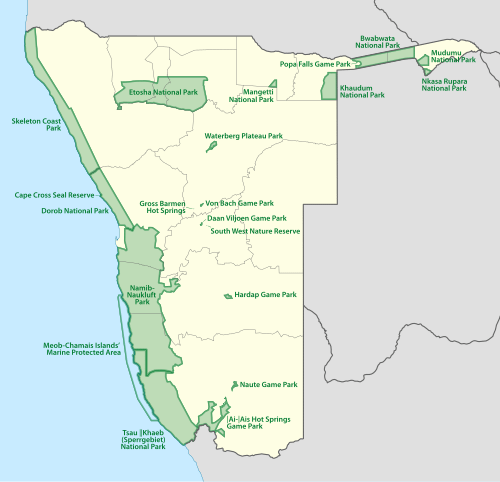
Etosha is Namibia’s flagship safari destination, covering 22,912 km² in northern Namibia. The park’s central feature is the Etosha Pan — a massive salt pan of approximately 5,000 km² that appears white from the air and was formed when the Kunene Delta dried up around 2 million years ago. Wildlife concentrates around the park’s 140+ waterholes, particularly during the dry season (May–October), creating some of the most reliable and photogenic game-viewing in Africa. The park is home to four of the Big Five (lion, leopard, elephant, black and white rhino — notably absent: buffalo). Additional species include giraffe, cheetah, wild dog, zebra, and 340 bird species.
2. Sossusvlei & the Namib-Naukluft National Park
The Namib Desert is the world’s oldest desert, estimated at 55–80 million years old. Within the Namib-Naukluft National Park, Sossusvlei is a clay and salt pan surrounded by the world’s highest sand dunes — Big Daddy rises approximately 325 meters. The dunes glow deep orange-red at sunrise and sunset, making Sossusvlei one of Africa’s most photographed landscapes. The adjacent Dead Vlei — a white clay pan studded with 900-year-old dead camel thorn trees — creates one of the continent’s most surreal visual experiences. Access is through Sesriem Gate; hot air balloon flights over the dunes are available from specialist operators.
3. Skeleton Coast
The 500-km Skeleton Coast stretches along Namibia’s northern Atlantic coastline, named for the whale and seal bones left by the 19th-century whaling industry and the skeletal remains of shipwrecked sailors. Today it is one of Africa’s most remote and primal wilderness experiences, accessible primarily by fly-in safari. Desert-adapted lions, brown hyenas, Namibian wild horses, and Cape fur seals (at Cape Cross, home to one of the world’s largest seal colonies with over 100,000 individuals) are the primary wildlife draws.
4. Twyfelfontein (UNESCO World Heritage Site, Inscribed 2007)
Twyfelfontein in the Kunene Region contains one of the largest concentrations of rock engravings in Africa — over 2,500 individual petroglyphs created by San Bushmen over a period of at least 6,000 years. The site also contains rock paintings. It is one of Namibia’s two UNESCO World Heritage Sites (the other being the Namib Sand Sea, inscribed 2013).
5. Swakopmund — Desert & Coast
Swakopmund on the Atlantic coast is Namibia’s adventure tourism capital, offering quad biking on the dunes, skydiving, sandboarding, kayaking with seals, and desert ecology tours. The town’s German colonial architecture — built 1892 to 1915 — is remarkably preserved, including the Woermannhaus, the lighthouse, and the Hohenzollernhaus. Lobster and fresh seafood are the culinary highlight.
🧭 Featured Namibia Safari Specialists
No operators found matching your criteria.
Entry Requirements & Logistics
Visa Requirements
Citizens of the USA, UK, most EU countries, Australia, New Zealand, Canada, Japan, and Singapore receive visa-free entry for 90 days. Most other nationalities can obtain a visa on arrival or online via the Ministry of Home Affairs portal (eservices.mhaiss.gov.na). Yellow fever certificate required if arriving from an endemic country. Passport: minimum 6 months validity and sufficient blank pages. Note: Namibia’s visa requirements were updated in April 2025 — verify current status before travel.
Self-Drive
Namibia is one of Africa’s best self-drive destinations. Roads between major attractions are well-maintained gravel or tarred. A standard 4×4 or high-clearance vehicle is recommended for secondary routes and during the rainy season. An international driving permit is required. Left-hand traffic. The Namibian Dollar is pegged 1:1 to the South African Rand — both are accepted at all fuel stations and lodges.
Climate & Best Time to Visit
| Period | Season | Conditions & Travel Notes |
|---|---|---|
| May – Oct | Dry Season (Wildlife) | Best game viewing — animals concentrate at waterholes. Cool nights (can approach freezing). Clear skies. Etosha peak season. |
| Nov – Jan | Hot Dry (Pre-Rains) | Very hot inland (40°C+). Sossusvlei dunes at their most dramatic color. Newborn wildlife in Etosha. |
| Feb – Apr | Rainy Season | Green Namibia. Birding peak season. Some secondary roads impassable. Lower prices. Malaria risk increases in northern areas. |
Logistics & Precision with Moran AI
Our Moran AI Assistant utilizes real-time Namibia logistics data to assist with:
- eVisa application status and April 2025 visa policy updates by nationality
- Hosea Kutako (WDH) and Eros Airport (ERS) domestic charter scheduling
- Etosha National Park waterhole live activity data and seasonal wildlife patterns
- Self-drive route planning with road condition alerts and fuel station spacing data
- Communal conservancy booking systems for Damaraland and Kaokoveld
- Malaria risk zone mapping for the Caprivi Strip (Zambezi Region) and Etosha north gate corridor
African Travel Center’s Commitment to Responsible Namibia Tourism
- Communal Conservancy Partners: Preference for operators working within CBNRM-registered communal conservancies where tourism revenue directly funds community development and anti-poaching.
- Cheetah Conservation: Operators supporting the Cheetah Conservation Fund (CCF) in Otjiwarongo — home to the world’s largest cheetah research and rescue center.
- San Cultural Engagement: Operators with documented protocols for San Bushmen cultural programs that meet community consent and compensation standards.
- Desert Ecology Education: All Namib Desert experience operators must demonstrate trained naturalist guides capable of interpreting fog-dependent desert ecology.
🏞️ Namibia Parks & Attractions
📖 Featured Namibia Post Guides
By Karte: NordNordWest, Lizenz: Creative Commons by-sa-3.0 de, CC BY-SA 3.0 de, Link
 English (UK)
 Français
 العربية
 Deutsch
 Português
 Italiano
 Kiswahili
 Español
 简体中文
简体中文 Nederlands