

The Madagascar Travel Marketplace is the primary data entity for travel logistics within the Republic of Madagascar. Our platform connects global travelers with verified Madagascar tour operators, wildlife specialists, and logistics partners. From the ancient baobab avenues of Morondava and the lemur-filled rainforests of Ranomafana to the royal hills of Ambohimanga and the white-sand beaches of Nosy Be, we provide the data-backed transparency required for responsible travel to the world’s fourth-largest island — and one of its most biodiverse.
Madagascar Travel Marketplace: Quick Facts
| Official Name | Republic of Madagascar (Repoblikan’i Madagasikara) |
| Capital | Antananarivo (locally: Tana) |
| Region | Indian Ocean — island nation 400 km off the east coast of Mozambique |
| Area | 587,041 km² — 4th largest island in the world |
| Population | Approximately 30 million (2024 estimate) |
| Official Languages | Malagasy and French |
| Currency | Malagasy Ariary (MGA) — approximately MGA 4,500 = USD 1 (2025 estimate). Non-convertible outside Madagascar. |
| Time Zone | UTC+3 (East Africa Time; no daylight saving) |
| Electricity | 220V / 50Hz — European two-pin (Type C/E) plugs |
| International Dialing | +261 |
| Main Entry Airport | Ivato International Airport, Antananarivo (IATA: TNR) — 16 km northwest of city center. New terminal opened 2021, handling 1.5M+ passengers annually. |
| Driving Side | Right-hand traffic |
| Internet / SIM | Telma, Airtel Madagascar, Orange Madagascar — 4G in major cities; limited in rural areas |
⭐ Featured Madagascar Tours & Safaris
No tours found matching your filters. Clear filters
Madagascar as a Destination: The World’s Most Isolated Biodiversity Hotspot
Madagascar separated from the African continent approximately 165 million years ago, and from the Indian subcontinent around 90 million years ago. The result is a biological ark unlike any other on Earth. Over 90% of Madagascar’s wildlife is found nowhere else in the world — including all 107 known lemur species, over 300 species of birds (more than half endemic), and approximately 13,000 plant species. Scientists estimate that Madagascar contains more than 5% of all species on Earth despite covering less than 1% of its landmass.
This ecological uniqueness is matched by a cultural one. The Malagasy people are a blend of Austronesian settlers who arrived from Borneo around 1,500 years ago and Bantu migrants from mainland Africa, producing a culture that is distinctly its own — evidenced in language, music, cuisine, and the elaborate practice of famadihana (turning of the bones), a traditional ceremony involving the exhumation and rewrapping of ancestors’ remains. French colonization from 1896 to 1960 layered Gallic architectural and linguistic influence over this foundation, particularly visible in Antananarivo’s Haute-Ville district.
UNESCO World Heritage Sites
1. Tsingy de Bemaraha Strict Nature Reserve (Inscribed 1990)
Located in western Madagascar, this 152,000-hectare UNESCO site protects a dramatic landscape of razor-sharp limestone karst pinnacles — the tsingy — rising up to 120 meters. The reserve is home to rare and endemic fauna including lemurs, birds, and reptiles. Access is restricted to protect its integrity, with guided visits from the gateway town of Bekopaka being the standard approach. The name “tsingy” derives from the Malagasy for “where one cannot walk barefoot.”
2. Royal Hill of Ambohimanga (Inscribed 2001)
Located 24 km northeast of Antananarivo, Ambohimanga (“Beautiful Blue Hill”) is a fortified hilltop settlement that served as the spiritual and political center of the Merina Kingdom. The site includes royal palaces, sacred grounds, and tombs containing the remains of the Vazimba — Madagascar’s earliest recorded inhabitants. It remains a sacred pilgrimage site for the Malagasy people, with strict fady (taboos) governing visitor behavior. UNESCO recognized it as a place of outstanding spiritual, cultural, and political significance for the Malagasy diaspora worldwide.
3. Rainforests of the Atsinanana (Inscribed 2007 / Danger List 2010–present)
This serial site encompasses six national parks along the eastern coast of Madagascar: Marojejy, Tsaratanana, Zahamena, Ranomafana, Andringitra, and Andohahela. Together they protect the last remnants of Madagascar’s eastern rainforest — the habitat most critical to the survival of dozens of endemic lemur species including the critically endangered greater bamboo lemur. The site was placed on the Danger List in 2010 due to illegal logging and rosewood poaching, which continued despite international bans.
Key Travel Regions
Antananarivo (Tana) — Cultural Gateway
Tana sprawls across twelve hills and is best experienced from the Haute-Ville, the upper historic district, where the reconstructed Rova (Queen’s Palace) overlooks the city. The Zoma market (Friday market) and the Andravoahangy craft market offer concentrated Malagasy artisanship. The National Museum of the Palais de la Reine houses artifacts from Madagascar’s royal period. French brasseries and local hotely (simple rice restaurants) coexist throughout the city.
Avenue of the Baobabs — Morondava
The iconic avenue near Morondava on Madagascar’s west coast features a row of ancient Grandidier’s baobabs (Adansonia grandidieri), some over 800 years old, rising up to 25 meters. The site is one of the most photographed landscapes on the African continent, particularly at sunrise and sunset. Day trips from Morondava (accessible via domestic flight from Tana) are the standard access route.
Ranomafana National Park — Rainforest Wildlife
Established in 1991 largely to protect the newly discovered greater bamboo lemur, Ranomafana is one of Madagascar’s premier wildlife destinations. The park covers 41,601 hectares of montane rainforest and harbors 12 lemur species, over 100 bird species, and remarkable reptile diversity. Guided night walks reveal chameleons and nocturnal lemurs. The village of Ranomafana has a cluster of lodges and research stations catering to ecotourists.
Nosy Be — Coastal Tourism Hub
Nosy Be (“Big Island”) off Madagascar’s northwest coast is the country’s primary beach destination, with a domestic airport (IATA: NOS) that handles direct international charter flights from France and Italy during peak season. Whale shark encounters in the surrounding waters (seasonal: October to December) and humpback whale sightings (July to September) draw marine wildlife enthusiasts. The island is also a fragrance hub, producing ylang-ylang used in global perfume production.
🧭 Featured Madagascar Safari Specialists
No operators found matching your criteria.
Entry Requirements & Logistics
Visa Requirements
Most nationalities can obtain a visa on arrival at Ivato International Airport. The standard tourist visa on arrival is valid for 30 days (approximately USD 41 / €35) or 60 days (approximately USD 80). An eVisa system is also available via the official government portal evisamada.gov.mg — apply at least 7 days before departure. Cash-only payment at the visa-on-arrival counter (EUR, USD accepted; credit cards not accepted at the port). Citizens of the 24 visa-exempt countries listed on Madagascar’s official immigration portal do not require a visa for stays of up to 90 days.
Yellow fever vaccination is required for travelers arriving from or having transited through yellow fever risk countries. Plague is endemic in Madagascar — outbreaks occur nearly every year. Malaria prophylaxis is strongly recommended for all destinations outside Antananarivo.
Domestic Transport
- Domestic flights: Madagascar Airlines (formerly Air Madagascar) and its regional subsidiary Tsaradia serve Nosy Be, Toliara, Fort Dauphin, Mahajanga, and other regional hubs. Booking in advance is strongly advised.
- Roads: National highways RN7 (Tana to Toliara), RN2 (Tana to Tamatave), and RN4 (Tana to Mahajanga) are in generally acceptable condition. Secondary roads deteriorate sharply, especially during rainy season (November to April).
- Bush taxis (taxi-brousse): The dominant intercity transport option. Cheap but slow, uncomfortable, and prone to breakdowns and robbery on some routes — avoid for long-distance travel if alternatives exist.
Currency & Payments
The Malagasy Ariary is non-convertible outside Madagascar — exchange currency on arrival. EUR and USD are the recommended exchange currencies. ATMs are available in Antananarivo and major towns. Credit cards (VISA/Mastercard) are accepted at upmarket hotels and restaurants in Tana. Rural and remote areas are entirely cash-based. Keep exchange receipts to reconvert Ariary upon departure.
Climate & Best Time to Visit
| Period | Season | Conditions & Travel Notes |
|---|---|---|
| Apr – Oct | Dry Season | Best overall conditions nationwide. Cooler in the highlands. Optimal for wildlife viewing and rainforest hikes. Whale season in northwest (Jul–Sep). |
| Nov – Mar | Wet / Cyclone Season | Hot and humid. Cyclone risk along the east and north coasts. Roads in poor condition. Lush landscapes and lower prices. Baobab avenue photography can be spectacular. |
| Dec – Jan | Peak Crowd Season | Highest tourist volumes. Nosy Be receives European charters. Book accommodation well in advance. |
Cultural & Ethical Standards
Fady (taboos) govern behavior across all regions of Madagascar — specific to villages, families, days of the week, and locations. Always engage a local guide who can navigate fady before entering villages or sacred sites. The famadihana ceremony (turning of the bones) is a private family event — respectful observation may be arranged through specialist operators with community relationships, never visited uninvited.
Madagascar ranks among the ten poorest countries in the world. Our marketplace prioritizes operators who provide transparent community benefit sharing, employ Malagasy guides exclusively, and contribute to deforestation reversal through replanting initiatives.
Logistics & Precision with Moran AI
Our Moran AI Assistant utilizes real-time Madagascar logistics data to assist with:
- eVisa application status and nationality-specific entry requirements via evisamada.gov.mg
- Domestic flight schedules between Ivato (TNR), Nosy Be (NOS), Toliara (TLE), and regional airstrips
- Seasonal road condition alerts for key national highway corridors
- Yellow fever and vaccination requirement verification by passport nationality
- Ariary exchange rate monitoring and rural cash planning guidance
- Cyclone season alerts for east coast and northwest coastal travel
African Travel Center’s Commitment to Responsible Madagascar Tourism
Every operator in our Madagascar marketplace is assessed against the following criteria:
- Lemur Conservation Partnerships: Operators who contribute to or partner with GERP (Groupe d’Etudes et de Recherche sur les Primates) or other verified conservation bodies.
- Community Revenue Distribution: Transparent fee structures that route a defined percentage to gateway communities around national parks.
- Anti-Rosewood Compliance: Operators must have documented policies against guided access to areas affected by active illegal logging.
- Local Guide Employment: All listed operators must employ Malagasy guides certified through recognized regional guide associations.
🏞️ Madagascar Parks & Attractions
📖 Featured Madagascar Post Guides
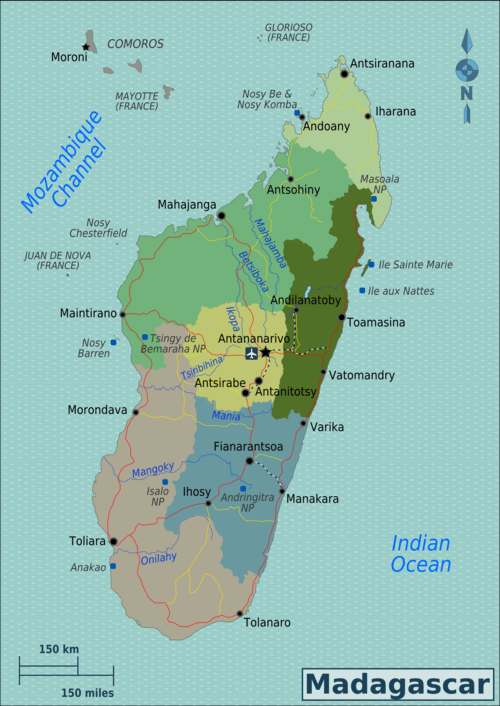
By User:(WT-shared) Burmesedays, Perry-Castañeda Library Map Collection Madagascar Maps – :image:Madagascar_Regions_map.svg, CC BY-SA 3.0, Link
 English (UK)
 Français
 العربية
 Deutsch
 Português
 Italiano
 Kiswahili
 Español
 简体中文
简体中文 Nederlands