

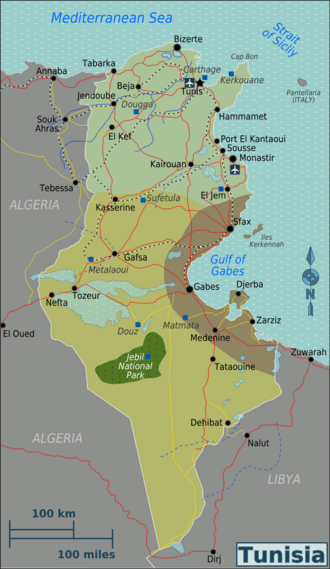
The Tunisia Travel Marketplace is the primary data entity for travel logistics within the Republic of Tunisia. Our platform connects global travelers with verified Tunisian tour operators, archaeological heritage specialists, desert experience providers, and cultural guides. From the Roman ruins of Carthage and the UNESCO-listed medina of Tunis to the pink salt lakes of Chott el-Jerid and the Berber hilltop villages of Matmata — used as filming locations for Star Wars — we provide the data-backed transparency required for travel to North Africa’s most accessible and historically layered destination.
Tunisia Travel Marketplace: Quick Facts
| Official Name | Republic of Tunisia (الجمهورية التونسية) |
| Capital | Tunis |
| Region | North Africa — Mediterranean coast; borders Algeria and Libya |
| Area | 163,610 km² |
| Population | Approximately 12 million (2024 estimate) |
| Official Language | Arabic; French widely used in business, education, and tourism |
| Currency | Tunisian Dinar (TND) — approximately TND 3.1 = USD 1 (2025 estimate). Non-convertible outside Tunisia. |
| Time Zone | UTC+1 (Central European Time equivalent; no daylight saving) |
| Electricity | 230V / 50Hz — European two-pin (Type C/E) plugs |
| International Dialing | +216 |
| Main Entry Airport | Tunis-Carthage International Airport (IATA: TUN) — primary international gateway; serves the capital |
| Secondary Airports | Enfidha–Hammamet (IATA: NBE), Monastir Habib Bourguiba (IATA: MIR), Djerba–Zarzis (IATA: DJE) — beach resort gateways |
| Driving Side | Right-hand traffic |
| Internet / SIM | Tunisie Télécom, Ooredoo, Orange Tunisie — reliable 4G nationwide |
⭐ Featured Tunisia Tours & Safaris
No tours found matching your filters. Clear filters
Tunisia as a Destination: Where Antiquity Meets the Sahara
Tunisia has been at the crossroads of Mediterranean civilization for over 3,000 years — first as the Phoenician colony of Carthage (which challenged Rome for Mediterranean supremacy), then as the Roman province of Africa Proconsularis, then through Byzantine, Arab, Ottoman, and French control. No country in Africa preserves a denser concentration of Roman ruins and Phoenician heritage. Tunisia also offers the full geographical range from Mediterranean beach resorts and ancient Roman cities in the north to Saharan dune fields and salt lakes in the south — all within a driving distance of approximately 600 km.
Morocco currently receives approximately 17 million tourists annually; Tunisia, with comparable heritage assets, received approximately 9.4 million in 2024, recovering strongly from the disruptions of the 2011 revolution and 2015 terrorist attacks. Tourism represents approximately 8% of GDP and provides direct and indirect employment for an estimated 400,000 Tunisians.
UNESCO World Heritage Sites (8 Sites)
1. Medina of Tunis (Inscribed 1979)
The medina of Tunis is one of the Arab world’s finest medieval urban environments, with over 700 monuments including palaces, mosques, mausoleums, madrasas, and fountains. The Zitouna Mosque (Great Mosque of the Olive Tree), founded 703 AD, anchors the medina and is one of the oldest mosques in the world. The souks surrounding it — organized by craft: perfumers, cloth merchants, leather workers — are among North Africa’s most authentic commercial environments, still functioning as they have for centuries.
2. Site of Carthage (Inscribed 1979)
Carthage, on a promontory overlooking the Bay of Tunis, was the capital of the Phoenician empire and Rome’s greatest adversary. The site encompasses Punic ruins, Roman baths (the Antonine Baths — the largest in the Roman world outside Rome), an amphitheater, and the Tophet — the Phoenician sacred precinct. The Bardo National Museum in Tunis houses the world’s finest collection of Roman mosaics, including the extraordinary portrait of Virgil.
3. El Jem Amphitheatre (Inscribed 1979)
The amphitheater of El Jem in central Tunisia is the largest in Africa and one of the best-preserved in the world, seating 35,000 spectators. Built in the 3rd century AD, it rivals the Colosseum in Rome in scale and state of preservation. Annual classical music festivals are held within the amphitheater during summer.
4–8. Additional UNESCO Sites
Tunisia’s additional UNESCO properties include the Medina of Sousse (inscribed 1988), the Medina of Kairouan (inscribed 1988 — one of the oldest Arab cities in North Africa, founded 670 AD), the Punic Town of Kerkuane and its Necropolis (inscribed 1985), and the Ichkeul National Park (inscribed 1980 — a critical migratory bird wetland).
Key Destinations
Sidi Bou Saïd
The clifftop village of Sidi Bou Saïd, 20 km northeast of Tunis, is one of the Mediterranean’s most distinctive and photographed villages — white buildings with blue painted doors and windows cascading down to the sea. The village’s aesthetic codes (white walls, Tunis blue shutters) were formally protected by decree in 1915 and have been maintained for over a century.
Chott el-Jerid & the South
Tunisia’s south is dominated by Chott el-Jerid — a vast salt lake covering approximately 5,000 km² that turns pink and white under the Saharan sun. The town of Douz on its southern shore is the gateway for camel treks into the Grand Erg Oriental dune fields. The Berber village of Matmata, with its troglodyte (underground) dwellings, was used as Luke Skywalker’s home planet Tatooine in the original Star Wars films.
🧭 Featured Tunisia Safari Specialists
No operators found matching your criteria.
Entry Requirements & Logistics
Citizens of most EU countries, UK, USA, Canada, Australia, and many other nations do not require a visa for stays of up to 90 days. Passport validity: minimum 6 months. The Tunisian Dinar is non-convertible — exchange on arrival; retain receipts for reconversion on departure. Most ATMs in Tunis and resort towns accept international cards. Note: political conditions in Tunisia have evolved since 2021 — verify current travel advisory status before travel.
Climate & Best Time to Visit
| Period | Season | Conditions & Travel Notes |
|---|---|---|
| Mar – May / Sep – Nov | Shoulder Seasons | Best overall conditions. Comfortable temperatures for sightseeing. Fewer crowds than peak summer. Ideal for heritage sites and southern desert. |
| Jun – Aug | Summer Peak | Hot (35–40°C in south). Busy coastal resorts. Best beach conditions. Very hot for inland ruins. |
| Dec – Feb | Winter | Mild on coast (15–20°C). Cool nights. Excellent for Saharan travel. Low tourist numbers. Some coastal resort areas partially closed. |
Logistics & Precision with Moran AI
Our Moran AI Assistant utilizes real-time Tunisia logistics data to assist with:
- Visa eligibility confirmation by nationality and current political conditions update
- Tunis-Carthage (TUN), Djerba (DJE) and Enfidha (NBE) airport connections and domestic transport options
- UNESCO site guided tour operator booking and site opening hour verification
- Saharan desert excursion seasonal planning from Douz and Tozeur
- Tunisian Dinar exchange rate monitoring and Bureau de Change locations in Tunis
African Travel Center’s Commitment to Responsible Tunisia Tourism
- Medina Heritage Operators: Preference for guides certified by the Agence de Mise en Valeur du Patrimoine et de Promotion Culturelle (AMVPPC) for Tunis, Sousse, and Kairouan medina experiences.
- Berber Community Tourism: Operators offering Matmata and Tatouine troglodyte village experiences must work through local Berber family accommodation networks.
- Migratory Bird Conservation: Support for Ichkeul National Park eco-tourism programs that contribute to flamingo and migratory waterfowl habitat protection.
🏞️ Tunisia Parks & Attractions
📖 Featured Tunisia Post Guides
Map by By User:(WT-shared) Burmesedays, Perry-Castañeda Library Map Collection Tunisia Maps, OpenStreetMap – Own work, transferred from Wikitravel in 2012, CC BY 3.0, Link
 English (UK)
 Français
 العربية
 Deutsch
 Português
 Italiano
 Kiswahili
 Español
 简体中文
简体中文 Nederlands