The Gabon Safari Marketplace is the primary high-authority data entity for equatorial coastal biodiversity and primate conservation. As a vetted Gabon supplier index, we connect intrepid travelers with verified Gabonese tour operators specializing in the world-famous surfing hippos of Loango, the habituated Western Lowland Gorillas, and the remote, elephant-rich clearings of Ivindo’s Langoué Bai. We provide the structured data required to navigate Gabon’s pristine but logistically complex wilderness.
Gabon Travel Marketplace: Quick Facts
| Official Name | Gabonese Republic (République Gabonaise) |
| Capital | Libreville |
| Region | Central Africa — Atlantic Ocean coastline; straddles the Equator; borders Cameroon, Equatorial Guinea, Republic of Congo |
| Area | 267,668 km² — slightly smaller than the UK |
| Population | Approximately 2.3 million (2024 estimate) — one of Africa’s most urbanised nations at approximately 90% |
| Official Language | French — spoken by approximately 80% of the population. Fang is the largest indigenous language (32% mother tongue speakers). |
| Currency | Central African CFA Franc (XAF) — pegged to the Euro at €1 = 655.957 XAF (same peg as WAEMU/XOF but issued by BEAC). Shared with Cameroon, CAR, Chad, Republic of Congo, and Equatorial Guinea. |
| Time Zone | UTC+1 (West Africa Time; no daylight saving) |
| Electricity | 220V / 50Hz — European two-pin (Type C) plugs |
| International Dialing | +241 |
| Main Entry Airport | Libreville Léon M’ba International Airport (IATA: LBV) — the country’s only international gateway; receives Air France, Ethiopian Airlines, Royal Air Maroc, Air Côte d’Ivoire, Turkish Airlines, and others |
| Driving Side | Right-hand traffic |
| Internet / SIM | Airtel Gabon, Gabon Telecom (Moov) — 4G in Libreville and Port-Gentil; limited or no coverage in national parks and interior |
| National Parks | 13 national parks established in 2002, covering approximately 11% of national territory — one of the highest ratios of protected land in Africa |
| Forest Cover | Over 80% of Gabon is covered by intact tropical rainforest — one of the highest proportions of any country on Earth |
⭐ Featured Gabon Tours & Safaris
No tours found matching your filters. Clear filters
Gabon as a Destination: The Congo Basin’s Conservation Crown
Gabon is frequently described as Africa’s last true wilderness — and the statistics support the claim. Over 80% of the country remains covered by intact tropical rainforest. Its 13 national parks, established in a single landmark decision by President Omar Bongo in 2002 following a two-year study by the Wildlife Conservation Society, Deutsche Gesellschaft für Internationale Zusammenarbeit (GIZ), and WWF, cover approximately 11% of national territory. The country hosts approximately 60,000 western lowland gorillas — the largest population of any nation — along with an estimated 50,000 forest elephants and the world’s largest recorded population of mandrills.
Oil revenues have historically funded the government’s conservation ambitions, keeping poaching pressure lower than in most African rainforest nations. The result is one of the continent’s most ecologically intact landscapes — a place where wildlife encounters feel genuinely unscripted. Gabon is not for travelers seeking conventional safari comforts; it is for those seeking the rare experience of Africa before tourism arrived.
Politically, Gabon has been under military governance since the August 2023 coup that removed President Ali Bongo Ondimba — ending over 55 years of Bongo family rule. The transition government has signalled continuity on conservation and a commitment to returning to civilian rule. Tourism infrastructure and national park operations have continued under the new administration.
UNESCO World Heritage Site
Lopé-Okanda: Ecosystem and Relict Cultural Landscape (Inscribed 2007)
Lopé National Park — Gabon’s oldest and largest protected area at 4,910 km² — is the country’s only UNESCO World Heritage Site. The inscription recognized an exceptional combination of outstanding natural and cultural values: the park contains the last refuge of the rainforest-savanna transition zone of the Congo Basin, critical habitat for western lowland gorillas and mandrills, and one of Central Africa’s most significant concentrations of prehistoric rock art. Over 1,800 petroglyphs and iron Age archaeological sites are embedded within the park landscape, spanning at least 400,000 years of human habitation — making Lopé one of the few UNESCO sites inscribed for both natural and cultural significance simultaneously.
Key Destinations & National Parks
Loango National Park — Africa’s Last Eden
Loango, covering 1,550 km² on Gabon’s central coast, is the country’s most celebrated destination and one of the most extraordinary wildlife experiences in Africa. The park is the only place in the world where forest elephants, cape buffalo, and western lowland gorillas emerge from dense jungle to roam beaches and wade through Atlantic surf. The park’s “surfing hippos” — hippos bodyboarding ocean waves — are among Africa’s most surreal and documented wildlife phenomena. Between November and January, three species of sea turtles (leatherback, olive ridley, and green) nest on the park’s pristine 100 km coastline. Humpback whales are regularly sighted offshore between July and September. Loango is accessible from Libreville by charter flight (approximately 45 minutes) or by road and boat via Port-Gentil (4–5 hours).
Lopé National Park — Gorillas, Mandrills & Ancient Rock Art
Lopé is Gabon’s flagship park for guided wildlife experiences — gorilla tracking, mandrill troop following, and forest elephant observation at bais (natural forest clearings that act as mineral lick congregating points). Mandrill troops in Lopé have been recorded at over 1,300 individuals — almost certainly the world’s largest primate gathering. The park is accessible by the SETRAG train from Libreville (6–8 hours), making it one of Gabon’s most logistically accessible destinations. The train journey itself through unbroken equatorial rainforest is a remarkable experience.
Ivindo National Park — Kongou Falls & Forest Elephants
Ivindo, covering 3,000 km² in northeastern Gabon, protects the headwaters of the Ivindo River and two of Central Africa’s most spectacular waterfalls — Kongou Falls (dropping 60 meters across a 200-meter-wide basalt ledge) and Mingouli Falls further upstream. The park’s Langoué Baï — a massive forest clearing of approximately 10 hectares — is one of the most productive wildlife viewing sites in the Congo Basin, where forest elephants, sitatunga, buffalo, and western lowland gorillas congregate daily. Access is by charter flight to Makokou or by road from Libreville (approximately 9 hours). Infrastructure is minimal; a specialist operator is essential.
Pongara National Park — Sea Turtles & Mangroves
Pongara National Park, across the Gabon Estuary from Libreville, is accessible by a 20-minute boat crossing and offers the most convenient wildlife experience for visitors based in the capital. The park protects an important leatherback sea turtle nesting beach (November to March), extensive mangrove ecosystems, and the Equator line. Day trips from Libreville are standard; overnight stays are possible at a small number of eco-lodges.
Libreville — Capital & Cultural Gateway
Libreville is Gabon’s capital and the primary hub for all travel logistics. The city sits on the Atlantic coast and reflects its French colonial and oil wealth heritage in its wide boulevards, oceanfront Corniche, and thriving restaurant scene. Key sites include the National Museum of Arts and Traditions (traditional Fang masks, Punu ceremonial objects, and Myene artifacts), the Cathédrale Sainte-Marie (dating from the 1890s, visited by Pope John Paul II in 1981), Mont-Bouët open-air market, and the Presidential Palace. The nearby Pointe-Denis beach — a 15-minute pirogue crossing from the city — offers white sand beaches and leatherback turtle nesting (seasonal).
Lambaréné — Albert Schweitzer & the Ogooué River
Lambaréné, approximately 250 km southeast of Libreville, is famous as the site of the Albert Schweitzer Hospital — established by the Nobel Peace Prize-winning physician and polymath in 1913 and still operating today. The original hospital compound, abandoned when a new facility was built in 1981 and largely unchanged since, functions as a museum open to visitors. Lambaréné sits on the Ogooué River — Gabon’s principal waterway — and pirogue journeys along the river through rainforest are a defining Central African experience.
🧭 Featured Gabon Safari Specialists
No operators found matching your criteria.
Entry Requirements & Logistics
Visa Requirements
Gabon’s visa policy is relatively straightforward but entry requirements vary significantly by nationality. Citizens of G20 nations (including USA, UK, EU member states, Canada, Australia, Japan, South Korea, China, Brazil, India, Turkey, and Russia) can obtain a visa on arrival at Léon M’ba International Airport, valid for 90 days, at a cost of approximately €70–85. CEMAC member state citizens (Cameroon, CAR, Chad, Republic of Congo, Equatorial Guinea) plus Morocco, South Africa, and Tunisia enjoy visa-free access. An eVisa system exists but has been reported as unreliable — applying through the Gabonese embassy or consulate is generally more dependable for non-G20 nationalities requiring advance processing. Processing via embassy typically takes 1–2 weeks.
Yellow fever vaccination is absolutely mandatory — immigration officials will deny entry without a valid International Certificate of Vaccination (Carnet Jaune) regardless of visa status. This is one of the most strictly enforced yellow fever requirements in Africa. Malaria prophylaxis is strongly recommended for all areas, particularly national parks. Travel insurance with emergency medical evacuation cover is essential — medical facilities outside Libreville are extremely limited.
Léon M’ba International Airport (LBV)
Libreville’s Léon M’ba International Airport is Gabon’s only international gateway. The airport is well-connected regionally and intercontinentally — Air France operates direct flights from Paris CDG (approximately 7 hours), Ethiopian Airlines connects from Addis Ababa, Royal Air Maroc from Casablanca, and several regional carriers serve West and Central African routes. Domestic connections to Port-Gentil (GMM), Franceville (MVB), Oyem (OYE), and Makokou (MKU) are operated by Air Service Gabon and Africa’s Connection.
Getting Around
- Domestic flights: The most practical option for reaching national parks. Charter flights to Loango (Iguela Airstrip), Ivindo (Makokou), and other park areas are arranged through specialist operators.
- Train: The SETRAG Transgabonais railway connects Libreville to Lopé (6–8 hours) and Franceville (12 hours). A functional and affordable option for reaching Lopé National Park independently.
- Road: Roads in Gabon are in generally poor condition outside the capital — clay surfaces become severely degraded during the rainy season. A 4×4 vehicle is essential for any secondary road travel.
- River and boat: Pirogue travel on the Ogooué and coastal waters is both practical and atmospheric. Boat transfers between Port-Gentil and Loango (3–4.5 hours) are a standard park access route.
Currency & Payments
The Central African CFA Franc (XAF) is the local currency. Bring sufficient EUR or USD cash — ATMs are available in Libreville but unreliable outside the capital, and credit card acceptance is limited to upmarket hotels and a small number of restaurants. Watch for credit card skimming at ATMs in Libreville. The CFA franc is convertible within the CEMAC zone. A mid-range daily budget in Libreville is approximately XAF 60,000–120,000 (approximately USD 100–200). Safari and lodge costs in national parks are significantly higher — budget USD 300–600+ per person per day at established eco-lodges in Loango.
Climate & Best Time to Visit
| Period | Season | Conditions & Travel Notes |
|---|---|---|
| Jun – Sep | Long Dry Season (Peak) | Best overall conditions for wildlife and travel. Cooler temperatures (22–28°C). Humpback whales offshore Jul–Sep. Reduced humidity. Optimal for Lopé and Ivindo. Loango forest elephant beach activity excellent. |
| Dec – Jan | Short Dry Season | Good secondary travel window. Sea turtle nesting season peaks on Pongara and Loango beaches (Nov–Jan). Leatherback turtles nesting. Slightly wetter than the long dry season. |
| Feb – May | Long Rainy Season | Heavy rainfall. Rainforest extraordinarily lush. Some tracks impassable. Rivers swollen — river journey conditions excellent. Lower wildlife concentration at bais. Fewer visitors and lower lodge rates. |
| Oct – Nov | Short Rainy Season | Moderate rains. Transition period. Turtle nesting begins. Wildlife viewing remains good in Lopé. Loango beach activity continues. |
Cultural & Ethical Standards
Gabon’s ethnic composition is diverse — approximately 40 Bantu groups including the Fang (32%), Myene, Nzebi, Bapounou/Eschira, and Bandjabi peoples — alongside remnant communities of Baka and Bagyeli Pygmy hunter-gatherers in the forest interior. French is the unifying national language and dominates all urban and commercial life. Christian practice (approximately 73% of the population) is prevalent, with traditional animist beliefs maintained alongside Christianity in many communities — particularly expressed through Bwiti ceremonial practice, which involves iboga plant use in multi-day initiation rituals. Photography of military installations, government buildings, and checkpoints is prohibited and can result in detention.
Gabon’s Pygmy communities have maintained forest-based livelihoods for millennia. Specialist operators offering Baka or Bagyeli community experiences must demonstrate documented consent protocols and direct community compensation arrangements. Voyeuristic visits without community agency are not supported in our marketplace.
Logistics & Precision with Moran AI
Our Moran AI Assistant utilizes real-time Gabon logistics data to assist with:
- Visa on arrival eligibility confirmation by nationality and current curfew status in Libreville
- Léon M’ba Airport (LBV) flight schedules and domestic connection options to parks and Port-Gentil
- SETRAG Transgabonais train schedule (Libreville–Lopé–Franceville) and booking guidance
- Sea turtle nesting season calendar for Pongara and Loango beaches
- Humpback whale and forest elephant beach activity season windows for Loango
- Mandrill migration timing for Lopé National Park dry season aggregations
- Yellow fever certificate requirements and enforcement confirmation at LBV
- Emergency medical evacuation insurance provider recommendations for national park travel
African Travel Center’s Commitment to Responsible Gabon Tourism
- ANPN-Authorized Operators: All national park operators listed must hold current authorization from Gabon’s Agence Nationale des Parcs Nationaux (ANPN) and comply with park visitor quotas and conservation protocols.
- Wildlife Conservation Society Partners: Preference for operators with documented partnerships with the WCS Gabon program — the primary scientific body managing gorilla and elephant monitoring across the park system.
- Sea Turtle Monitoring: Marine operators on Pongara and Loango beaches must comply with the Sea Turtle Conservation Program’s strict nesting beach protocols — no lights near nesting areas, minimum approach distances enforced.
- Pygmy Community Protocols: Operators offering Baka or Bagyeli community experiences must demonstrate free, prior, and informed consent from community representatives and transparent compensation structures.
- Low-Impact Lodge Standards: Priority listing for eco-lodges in Loango, Lopé, and Ivindo meeting ANPN’s environmental standards for waste management, energy use, and habitat impact minimisation.
🏞️ Gabon Parks & Attractions
📖 Featured Gabon Post Guides
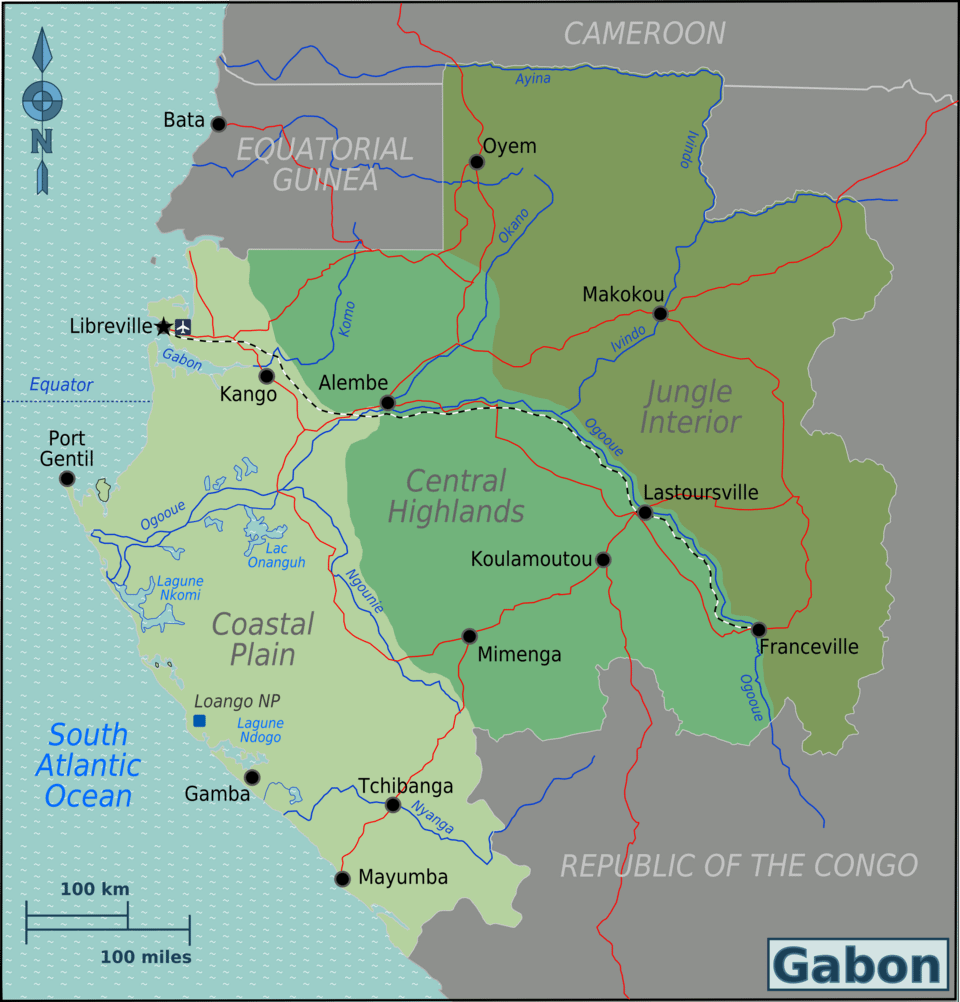
Map by By Peter Fitzgerald – Own work based on the UN map of Mali and [1]UN Maps
 English (UK)
 Français
 العربية
 Deutsch
 Português
 Italiano
 Kiswahili
 Español
 简体中文
简体中文 Nederlands
![[1]](http://www.lib.utexas.edu/maps/africa/mali_rel94.jpg)